

A couple of weeks ago I went to Ai4 in Vegas to see what’s transacting in the world of AI. I’ll be writing up more on that next week. But, in the meantime, I discovered the luxury watch market and how it works. Now, I’m fully aware this is its own niche with fierce fans and strong opinions, imprecision in my market segmentation, along with facts that I’m likely to butcher while writing this, so don’t rage DM me watch nerds ⌚🤓. This is just a look into a whole market and subculture I didn’t know even existed.
Most hotels on the Strip have effectively a shopping mall attached to them. The fancier hotels have high end brands like Tiffany, Prada, Gucci, etc. in their malls. For example, there are effectively 5 Tiffany stores on the strip alone. And the idea is that - there are no discounts to be had - you’ve traveled from somewhere to ... indulge... and what happens? You get a little tipsy? You just won some money? You don’t have to walk far to be able to be relieved of that cash. But watches, they have their own little economy that fits into this narrative.
What’s in the window is not for sale
Being guided by Daniyal Liaqat, a watch aficionado, as we wandered the Grand Canal Shoppes at the Venetian, I learned that if you walk into a Rolex store, for example, you can’t actually buy almost anything that’s on display. They may have a couple watches in stock, but those are usually on the order of $50,000 or so.
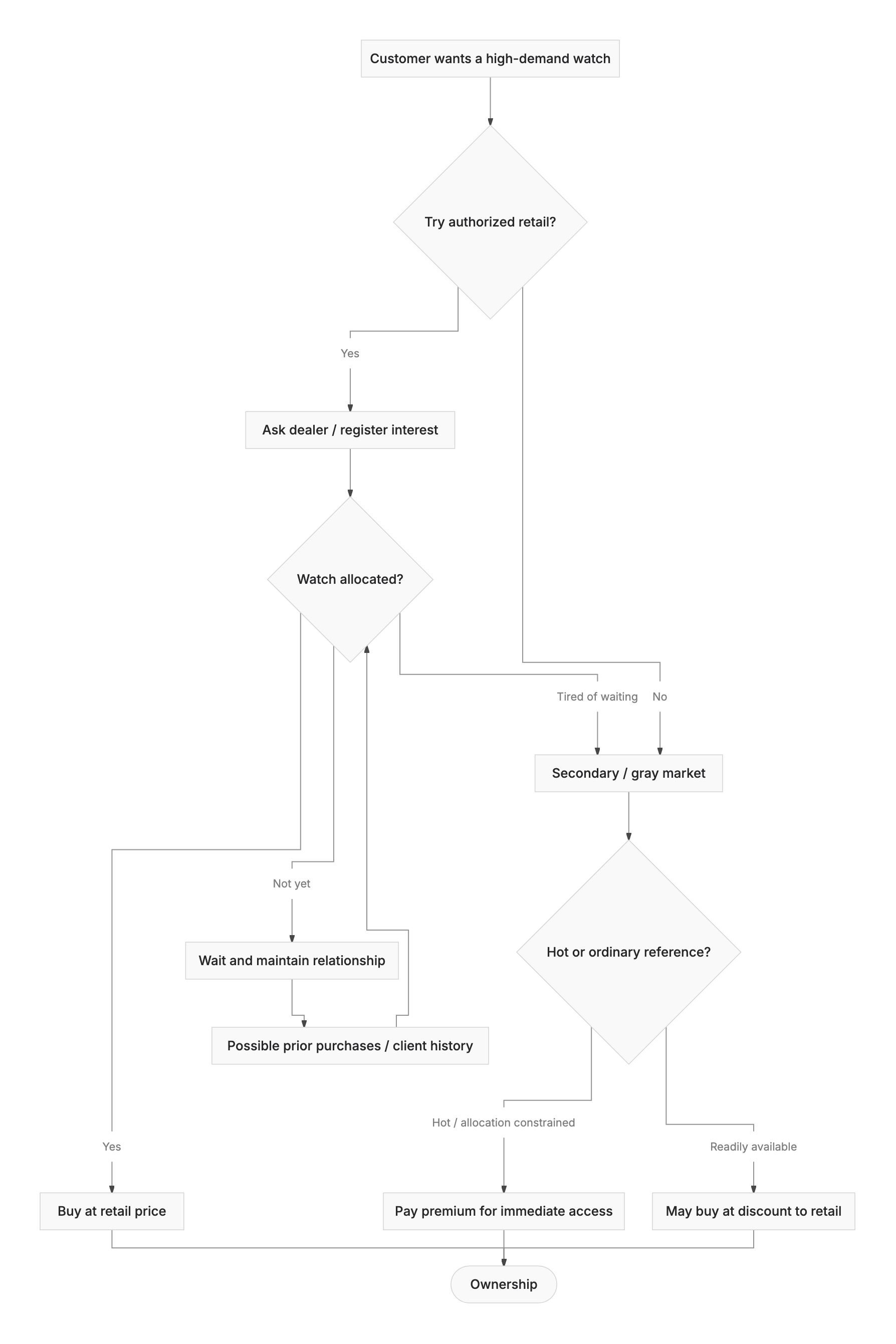
The watch you’ve been lusting after is likely not in stock at all and there’s a multi year queue to get it. You can get in line like a good citizen and wait your turn (but it’s not clear that your “turn” is as simple as being next on “the list”), or you can start buying watches and develop a relationship with the salesperson / retailer, who has a large amount of discretion about who they sell which watches to and when. A salesperson at A. Lange & Söhne told me that when they get a watch in stock, he gives his “next in queue” 24 hours to come and buy otherwise he goes to the next person on the list, no matter where they live.
As an aside, my understanding is that buying hard-to-get Ferraris and Hermès Birkin bags operate in a similar manner. I’d love to pretend I knew this firsthand from my buying patterns, but Apple’s offered me a big fat nothing given they own at least one of my kidneys at this point.
What’s not in the window is for sale
What blew my mind were the stainless steel watches. Many brands have what, on paper, should be cheaper watches that are not made of gold and diamonds but stainless steel. The thing is, you can’t buy them first. They’re not cheap, relatively speaking, even at the MSRP, but you effectively cannot buy them unless you’ve invested into a relationship with a given dealer and very likely having to have bought a few mid-five figure watches. One example is the Patek Philippe Aquanaut 5167A, a steel watch that costs about $27,000 but you can’t buy it without the right relationships and history. And then, if you want to skip the queue, on the secondary market, as of this writing, it is worth $71,000, a 162% premium. The dealer at Vacheron Constantin told me their super popular stainless steel model, the Overseas, is $25,000 - well below the other watch prices - but he wouldn’t display it as it would be an education conversation, not a sales one. And so it goes. You have to earn the right to buy.
Why not charge more?
Why don’t they just raise the price? Why do they let secondary markets capture the difference? Well, Thierry Stern, the president of Patek Philippe, told FT that “a steel watch has to be at a steel price”, and it can’t cost more than the more precious metal ones or ones that are technically more complicated. They are also making only so many watches so flooding the market with steel watches would leave money on the table for other, more premium watches they could be making. So we’ve got an engineered artificial scarcity situation going on here in order to keep the luxury brands perceived value high.
Here’s where it gets really crazy - like “you need an economics degree” crazy. And Rolex, from what I can tell, is at the forefront of this. Why sell a Daytona 126500 watch for $17k MSRP when you could get $32k for it? The primary benefit is marketing; now they can say without saying: “our $17k watch is so desirable that people are willing to pay $32k for it.” (It’s worth noting that Rolex does not claim to have a spend-to-qualify rule). And, should you be lucky enough to buy it, you feel privileged like you’ve won some sort of secret lottery iykyk. And, it keeps steel prices rational. And, a recent study (readable summary here) has found that foregoing short term profits actually can increase long term profits.
And, finally, it shields them from the collapse of the secondary market. If, say, Rolex just kept raising the prices based on demand, if the demand dropped for some reason, they’d have to cut prices. But luxury brands don’t cut prices. So they don’t have to worry about that - the secondary market can. After all, normally, watches devalue the second you buy them.
Who gets the call?
So you have a $17k watch that’s really worth $32k... how do you decide who gets one? It’s not a “just move to the next person on the list”, because that person could just make $15k later that day. This then becomes a line up of not customers but merchants, which is not what a brand would want, hence the human being with judgment standing between you and the watch. In this case, price isn’t the decision maker, it’s relationships, and the rationale does make sense in this wacky market. And the salesperson deciding whether you’re a customer or a secondary market merchant is also the person who can tell that you’re not ready and just show you a gold watch instead. From my side of the counter, I’m being screened and sold to at the same time.
As an aside, a crazy example of this going wrong is in the book Apple in China, where iPhone lineups in China were not what they seem - some were organized purchasing schemes.
But this isn’t about tech, Bob
Of course, cough, I spent most of my time at Ai4. So walking back from the malls to the conference, I came back with a different perspective. Not how much AI compute costs, but who’s allowed to buy it. But that’s next week’s post.
Daniyal is on a list, by the way. Somewhere out there a Rolex dealer has his phone number and control over his weekend two years from now.