
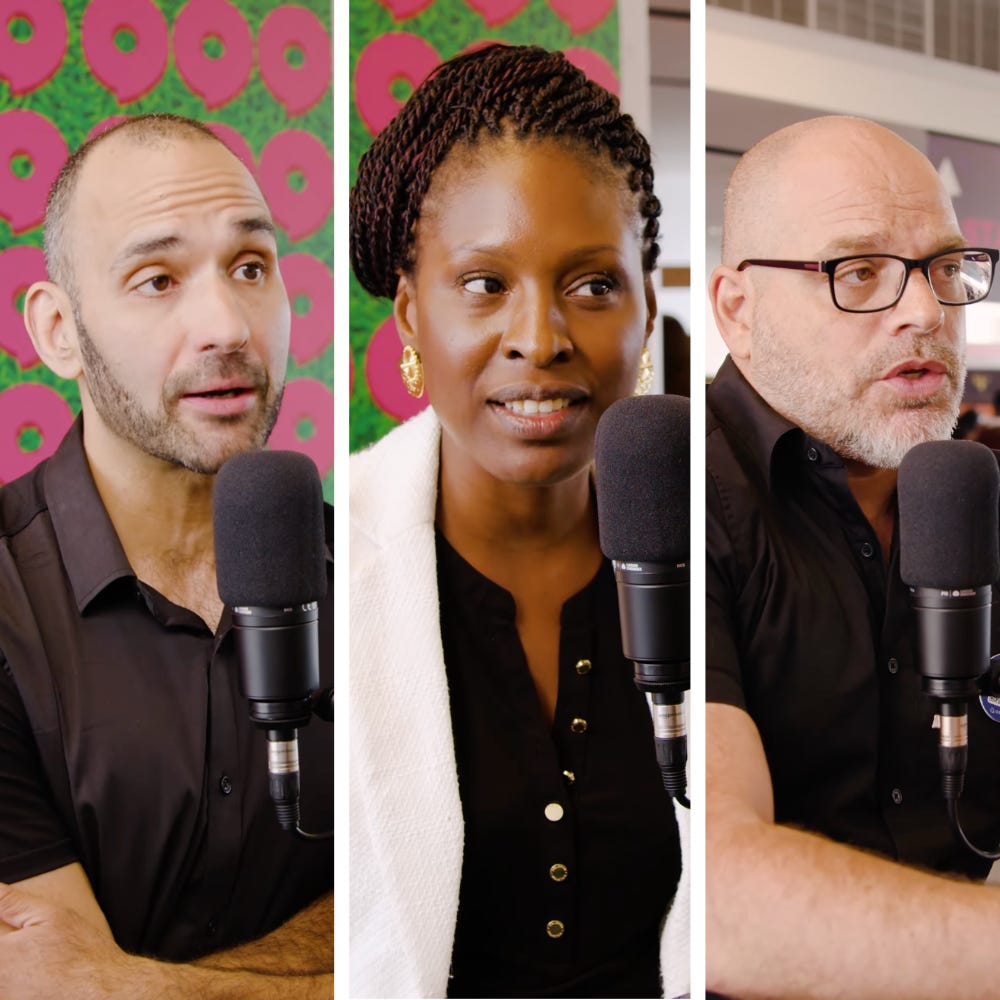
Lise Birikundavyi gave me the numbers before I’d finished my first question. Black founders are roughly four to five percent of the entrepreneurial population in Canada and take in about 0.8 percent of venture dollars. A Black woman sits at the intersection of both discounts and takes in around 0.34 percent. That’s messed up.
The reflex is to file this under fairness, and it is, but that isn’t how she pitches it. Lise co-founded BKR Capital, which invests in Black-led startups across Canada, and to her LPs the number isn’t a grievance, it’s a mispricing. “Go look for the arbitrage,” she told me. “Go where nobody else is looking.” She was one of three investors and ecosystem builders I spent two days with at StartupFest last summer whose job, stripped down, is to say yes before there’s any proof that yes is the right answer. The word all three of them kept reaching for was conviction, which is less a trait than a process: Lise, and then Nectar Economakis and Richard Chénier, each ran a different one, on different raw material, at a different scale. None of them found their conviction lying around. They manufactured it, and how they did it is the story.
Lise’s raw material is the overlooked, and she’s literal about it. When BKR likes a company it will often write the smallest cheque in the round and lead anyway: she does the diligence, puts her name down first, “and then you’re able to bring a lot of people around to support them.” The capital isn’t the product; going first is. And the same instinct that points her at the founder nobody’s funding points her at the sector nobody’s watching, which is why her deal flow is full of AI quietly eating HVAC, construction, auto repair, remittances, hair care - everyone else’s miss is the asset. Overlooked founders in overlooked markets. That’s conviction manufactured one deal at a time, the cheapest scale there is: there’s always something underrated, and being early to it is a call you can make alone on a Tuesday. Since 2021 BKR has read more than 1,600 decks and backed fifteen companies, and just held a $20-million first close on a second fund (Black Innovation Fund II, target $50 million), doubling down on that thesis.
Of course, there’s the old story that non-US markets tell themselves over and over again. It’s best summed up by a French expression Nectar Economakis quoted to me, one I loved: “nul n’est prophète en son pays.” No one is a prophet in his own country. He meant the Canadian founder who can’t get a local fund to lead a round until an American one does, at which point the locals reappear as if they’d been in the room the entire time. His partner Fred lived the undiluted version with his last company, Nubo: Series A led locally, numbers up and to the right, and then for the B, nobody. Fred came back with a term sheet from California and there was a stampede of follow-on. Same company, same numbers, same week. The only new fact in the world was that somebody else had gone first.
Nectar is trying to make a whole fund out of refusing to do that. Amiral Ventures invests seed to Series A in enterprise AI and industrial software, or in his own framing, “how do you make real shit in the economy.” When Amiral leads, the follow-on arrives, because follow-on was never the scarce thing. And the tell that he actually believes this is that it happened to him: for months his running joke was that he did venture but not capital, because the capital hadn’t shown up yet. Then one credible anchor LP committed, and the rest stopped asking whether the fund was real and started asking how to get in. Amiral held a $40-million first close at the end of last year, on the way to a $75-million target: the joke resolving itself in public.
Nectar’s approach runs the other direction. Lise’s conviction comes from something that already exists and is underpriced; his comes from an end state that doesn’t exist yet, reasoned backward into a bet. What he’s after, he’ll say flatly, is more big companies: one 200-billion-dollar company exists here, he wants ten, and ten flagships drag a whole layer of fifties and tens up behind them. You can argue with the number, but the point is that he reasoned his way to the bet rather than waiting for a term sheet from California to place it for him.
Then there’s Richard Chénier, who is attempting this at the scale of an entire economy, which is yet another version of hard. He runs Québec Tech, a nonprofit that launched at last year’s StartupFest, and his frustration is that the talent question is basically solved (the labs, the AI researchers, the quantum people, Yoshua Bengio more or less down the street) while the commercialization question is wide open, and the missing piece is that nobody will declare what the place will be great at. His phrase for the fix is “a right to win.” AI is not a sector, he kept insisting, and neither is quantum; they’re things you point at a sector. So pick the sectors where the strength is already real in Québec (energy, life sciences, aerospace, the industrial base) and aim the innovation and investment there on purpose.
Underneath the strategy vocabulary, what Richard is manufacturing is conviction at the level of a jurisdiction: an authoritative “this is the bet,” declared before there’s a result to justify it. And the reason it’s the hard version isn’t that the raw material is missing. The talent and the labs and the real sectoral strengths are all sitting right there. What’s missing is a shared decision about where to aim them, and that decision isn’t his to make alone. He’s the first to say the sectors have to be chosen with the Québec government, not announced over its head, because a bet the size of an economy only holds if the people who’d have to get behind it helped pick it. Lise and Nectar can each hold their conviction in their own two hands; Richard’s has to be held by a crowd and still point one direction. That’s the harder version of the same craft - not that theirs is easy. (Nectar had the cleanest image for it: Russian nesting dolls all the way back, until you reach the government going, well, I suppose we’re the ones who put the first money in.)
The one input that’s changed since we spoke is the world itself. A year ago, Nectar told me, if he’d said the word “defence” to his LPs they’d have run out of the room; now it’s a category with a straight face. Richard’s founders used to reflexively look south and now look to Europe and Asia. Whatever you think of the politics that did it, the effect on conviction was specific and fast: a set of bets that were unfundable in 2024 became obvious in 2025, almost overnight. A reminder that the belief was never really about the technology. The technology and the market sat there the whole time, patient, unchanged. What moved was permission.
Strip these three conversations down and the same fact sits under each: going first means being willing to be wrong out loud, before anyone can tell you whether you are. Lise built a fund on that. Nectar built a fund on that. Richard is trying to build a province on it. That’s the whole price of conviction.