
I met Ben Seidl in a Tesla on the Ai4 conference floor, where we had a chat about his startup, Autolane. Autolane builds the autonomous last-mile orchestration layer for delivery of, at least for now, food. Which is to say: software that dispatches self-driving cars to pick up and drop off food across a city, with a bit of hardware at either end.
Delivery on rails
What’s cool about it (to me) is how boring and necessary it is. They don’t build the cars or even the delivery apps, they’re the plumbing that connects to the food ordering and fulfillment platforms, the autonomous vehicles (initially a 2026 Tesla Model Y), and their customers. He says they’re like a “Stripe in the sense that [they’re] building the rails for a new type of commerce called autonomous commerce”. And, according to Ben, the opportunity is huge. He notes that Walmart’s Spark has more than 1 million unique drivers, which is a “fraction of their demand”. He’s betting on 5-10 million autonomous vehicles eventually.
And there’s a lot of complexity here. On the one hand, OEMs (automakers) are building their own autonomy stacks (Tesla and Rivian their own, others licensing Nuro or Wayve), and he maintains it will end up being a crappy user experience: a bunch of different robots and drones and trucks with different hardware and software showing up to stores and creating a confusing mess. On the other, Autolane does the hard work of integrating with each stack and being the single experience for retailers and ordering platforms, which is a ton of work itself. Tesla has robust APIs, so they started there.
They’re not attacking the top of the market to start (say, McDonald’s) because they have the tech teams that could possibly build out these sorts of integrations. Nevertheless, one could see a future where even they don’t want to maintain the tangle of integrations and just plug into Autolane. Their initial go-to-market is in Austin, since there’s a ton of full self-driving cars there (see my YouTube video of my trek in a Waymo), and a small chain of five-ish restaurants that wouldn’t / couldn’t normally invest in a solution like this. They just want a single point of connectivity, which is what Autolane gives them.
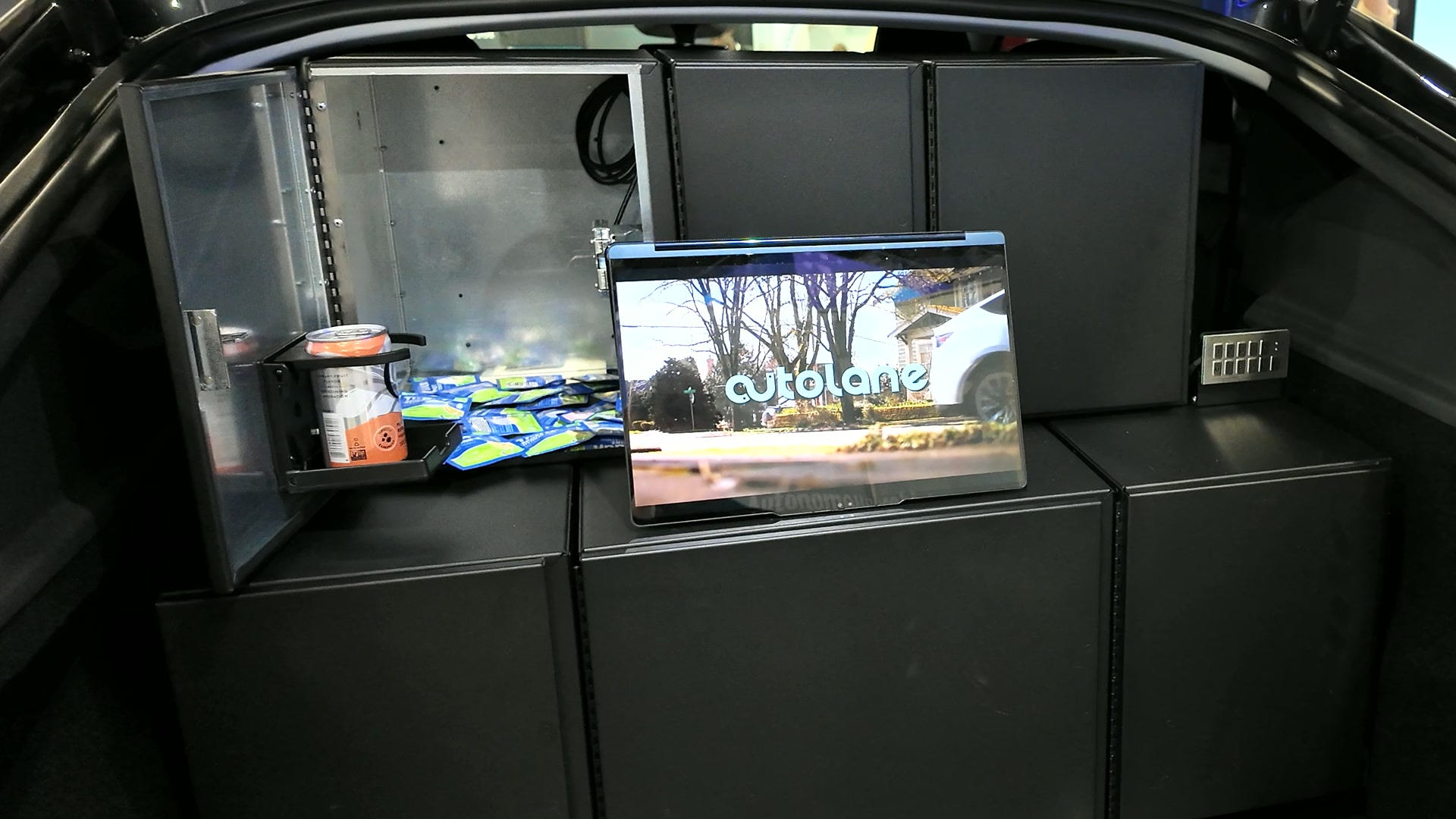
There is some hardware involved. Check out the video to see inside the trunk, where there are lockers for each order, and even an upcoming fridge / freezer setup. The car itself stops at a little solar-powered station, checks in and authenticates itself, pops the trunk, and the retailer puts the order in the right box, with their software acting as what Ben called “air traffic control.” He likens this to when you’d go to a numbered spot at, say, a Home Depot and someone brings your order out to you. All of this is engineered to “get the cost of delivery down.”
I did ask him about carmakers wanting to control their own stack, using GM and CarPlay as the obvious example. Then, surely because of me and my question, GM announced a new CarPlay layout for the 2027 Silverado and Sierra, and half the internet called it a climbdown.
Except it wasn’t, really. GM never removed phone mirroring from its gas trucks. It removed CarPlay and Android Auto from its EVs three years ago, and they’re still not coming back. What actually happened is that Mary Barra floated extending the ban to gas vehicles, owners revolted, and GM backed off within a week. Now it’s spending real engineering effort building a truce it pretty clearly never wanted to build.
And that actually makes Ben’s case better than a simple climbdown would have. He isn’t betting on automakers changing their minds. He’s betting on buyers changing their minds for them.
He also leaned into the idea that Elon Musk shared years ago: your car is idle for 23 hours of the day, so make it do something. Musk gave the example using your car’s idle time as a taxi for others, but Ben suggests it can even go get you food for no delivery fee.
It’s not a car anymore, and a phone isn’t a phone
I often think of it as funny that we call the iPhone the iPhone... who talks on the phone anymore? Maybe we should rename it the “Communicator” à la Star Trek.
To that end, Ben’s fundamental bet is that the object we call a car isn’t really what we think of as a car anymore. It does get you around, but it can be more: runs errands, gets groceries, drops off your dry cleaning, and earns pizza delivery money while you sleep. And I think he’s right.
China’s already living in it since they came late to the car manufacturing party and could leapfrog the rest of the world. Cars there are turning into third spaces for working, camping, and hanging out, which is not a feature list you’d write for a car.
A founder’s perspective
Aside from the novelty of the company itself, Ben’s thoughtfulness on entrepreneurship is what drew me into having this conversation. He’s forty-one, has raised from top-tier venture firms before and had it not work out, and isn’t interested in taking a pile of capital he’d then have to grow into. You know, the typical VC model: take ten times what you need and you’ve got about eighteen months to justify the number, then it’s a binary outcome. My favourite quote in our chat was: “I don’t care what our valuation is. Like we need enough money to get the things done on the roadmap that lead us to an IPO in five to ten years. However much money that is is how much money I need to go raise.”
He does have some choice observations about the current frothiness, including a warning about raising from a tier-1 VC: “the stakes become so high that if your business isn’t ready for that type of limelight and attention and speed, you will absolutely burn up very quickly.” On the twenty-three-year-olds walking around with hundred-million-dollar valuations, he reckons ninety-five percent go to zero, and that the motivation “is not the business, it’s not where the business is in five years.” Or, more succinctly: “if that’s just fictitious vibes, be careful.” There are more gems, but you gotta watch to hear them.
It’s the same bet twice over. The market shows up in five to ten years, and he’s funded it for five to ten years. After three days of demos priced for Q4, I found that weirdly refreshing.