

I was about to give up on the experiment of building a second brain after hours of futzing when something magical happened. I had ended a meeting the other day with a client and I took the meeting summary, dropped it into the client’s page, and my AI tools had already linked up the people on the call. One person had a missing page, so it created it. One person was, correctly, no longer relevant to the conversation because of the content of the conversation, so they were removed. And a third person it realized I had under a different record and wired them in.
So what’s a second brain? It’s effectively digital storage of everything you know that AI can query and act on. Imagine you remember not only everything that a doctor told you but have it searchable at hand at any time. Or you’re working long sales cycles and want to know the moment something changes at a company you’re tracking (cough - an area I know well - cough).
In the olden days, there were PIMs (personal information managers) like the Palm Pilot (it’s what got me into human-computer interaction and computer science, so sorry if I bring it up a lot). You’d take your contacts, meetings, reminders, and notes and offload it all there, saving your brain for the things it’s better at like... cogitating. Obviously, smart phones ate that market up. Then came tools like Evernote, Roam Research (hot for a minute), Logseq, Obsidian, and even Notion. The idea was to capture everything else, ideally synced for you to access anywhere. But you still had to search for notes and build context to eventually retrieve them and then have to mentally assemble everything yourself. And they don’t play nice with your email, text messages, and all the other relevant documents you work with. That’s a lot of work for a meh payoff.
Now your notes have a new reader
The AI revolution has had a few dramatic effects on this part of the software world, not least of which was to threaten the business model for all of these solutions. The other major shift has been the use of text files. AI loves text, so markdown has become super popular. Markdown is a simple-to-type text markup language invented by John Gruber of Daring Fireball fame to write quickly without having to hand edit HTML which was a pain (having started my career as a front-end web developer, I can attest to that). It’s simple text with some easily digestible characters for humans and AI to comprehend and doesn’t waste tokens with needless markup. Markdown won because the reader changed, not the writer.
The current version of the “second brain” came into vogue this year with the advent of OpenClaw and then Hermes, personal agents that can learn and save what they know, and you can interact with it yourself via regular markdown files. The basic premise is this: save everything about everything (people, email, work, you name it) in markdown files, then AI can act on it in amazing and novel ways. Immediately, however, the trouble was that everything about everything is not a filing system. Current thinking seems to have broken down into two components: knowledge about you and the knowledge you have.
The first component is knowledge about you. It’s best manifested by the Y Combinator’s CEO, Garry Tan, who built a structured way to manage your knowledge. He called it GBrain and it’s free on GitHub. If you look at some of the hot new uses of agents these days, most of them are developing the same graph of you in the background so they know who you are, what you like, and so on, so they can be helpful. I’m looking at you Meta’s Muse, Google’s Gemini Spark, and Instinct. Of course, you have to be comfortable having these companies learn even more about you, but the trade off is that they learn about you automatically and you give them hands to act on your behalf. And, as we’ve learned, if it’s free, you’re the product.
The second component, the knowledge you have, comes courtesy of Andrej Karpathy, now at Anthropic, who posted on X the idea of an LLM wiki to capture what you know. Casey Newton has a good write up of how he’s been using it. The general idea is that you build your knowledge database by saving what you’ve learned and read, then have AI synthesize that information itself into a wiki rather than a simple search of your sources. You have a growing set of knowledge that actually emerges out of what you’ve learned. Learning about investing? You can now build a definitive set of your knowledge that evolves as you evolve. Want to deeply understand a given market your business is focused on? Keep dumping your market research here, conversations, etc. and get a complete representation of what you know.
My brain lives on a Mac mini now
I just love the idea of full context with people and ideas so I’m spending time focusing on this set of ideas. Maybe it’s my entrepreneurial streak, but I think this is a great tool to manage long sales or partnership cycles as well as connect non-obvious dots. I also like the idea of having a clear mental model of how I work so I can just execute not reinvent my process all the time... says the person who definitely does not have ADHD.
So, I’ve chosen to experiment with moving off Notion to run Claude Code + GBrain + my own layer on top on my M1 Mac mini server, using Obsidian for notes, manage who and what I know, and, eventually, have the system start being a chief of staff at best or an executive assistant at worst. Or whatever the smart glasses whisper into my ear at that moment.
What’s the stack? Here’s where I’m at today:
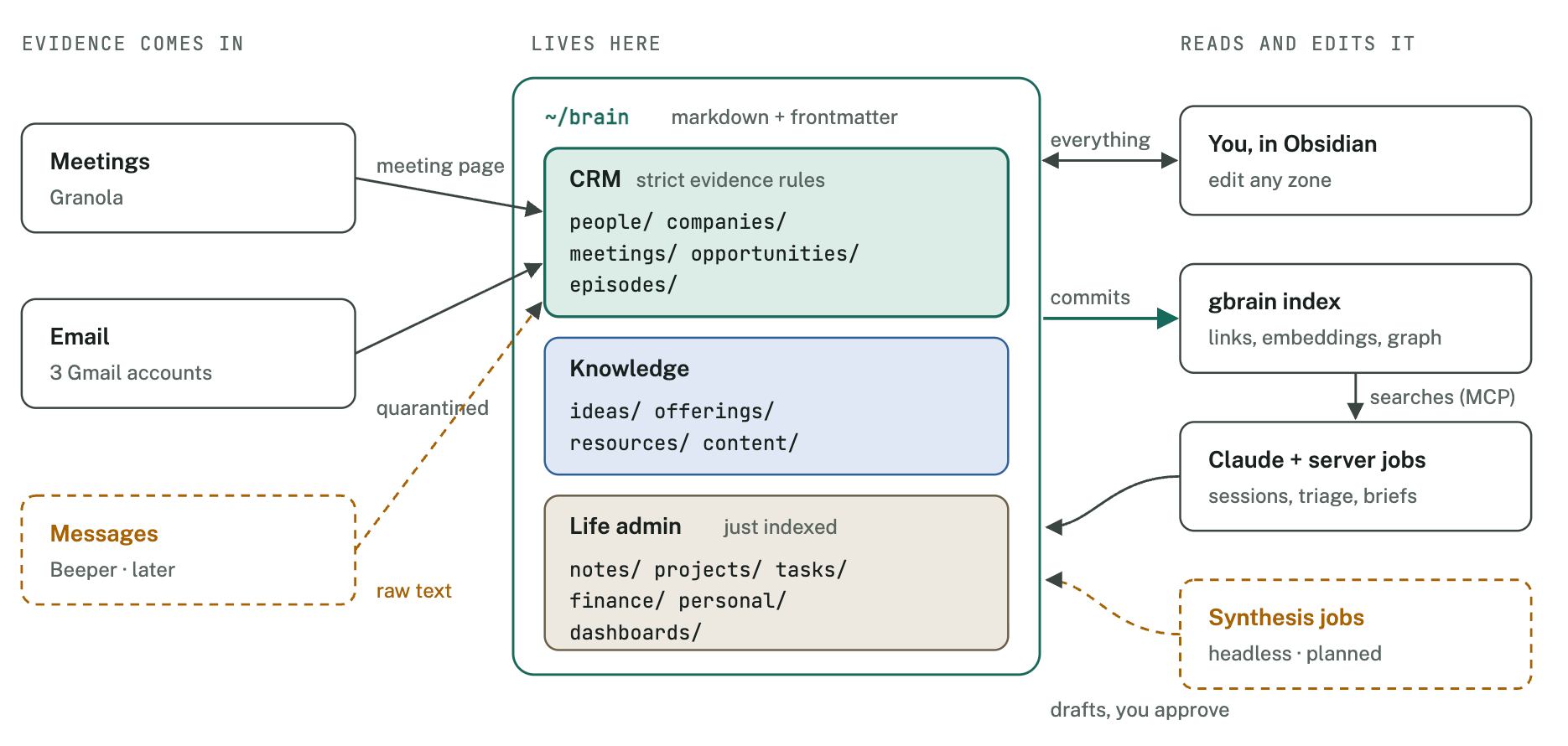
My process so far... and I’m early in this journey. First, have meetings with people, take notes and/or audio notes with, say, Granola, dump everything into that person or company’s page using Obsidian to edit the right file. Bring in other external sources to enrich or add context to people and companies. Next, let the brain wire up the people, companies, actions, etc. automatically. Finally, just ask your friendly AI a question of the brain and you’re off to the races.
The scenarios I’m more excited to get to are things like:
If I’m selling to a company, keep me on top of changes like hirings, firings, promotions, etc.
Someone asks me for a connection in my network that I can help introduce them to? Cool, do a double opt-in introduction.
I want to do a show or write an essay on a topic. Who in my network would be a good source or can get me to a good source?
Didn’t I help someone with a product they were building? Who was it and find me what I did for them so I can use that knowledge again.
What have I found so far?
It’s super nerdy and requires a bit of a developer brain to debug and fix when things don’t work. It couldn’t find a name of a client that is definitely there, so debugging was required.
I’m super nervous about security and it’s very front of mind for me. The idea of an email with hidden prompt instructions for an agent that has hands that can then share your personal notes with others is pretty scary.
Am I just removing my actual brain and allowing myself to bathe in metacognitive laziness?
I’m spending a bunch of time on the tooling itself rather than doing the work. Which brings me to...
Arranging pencils
My friend Heather has this expression that I love. She calls it “arranging pencils”, which is the work you do so that you can do the work, but in the meantime, the work itself never gets done. But, boy, does it feel productive.
Is this that? Is this me avoiding my deeply existential questions and scary work tasks by playing with AI toys? Am I just arranging AI pencils? (At least it’s not paperclips). I’m not sure yet. But am I building my own software company to do it?
I loved this post Rob -- so helpful, funny and authentic to whom I know you to be (helpful and funny). Thank you!! I have the deep context bit built (or brain piece) but I love the knowledge map idea! and will read the links