
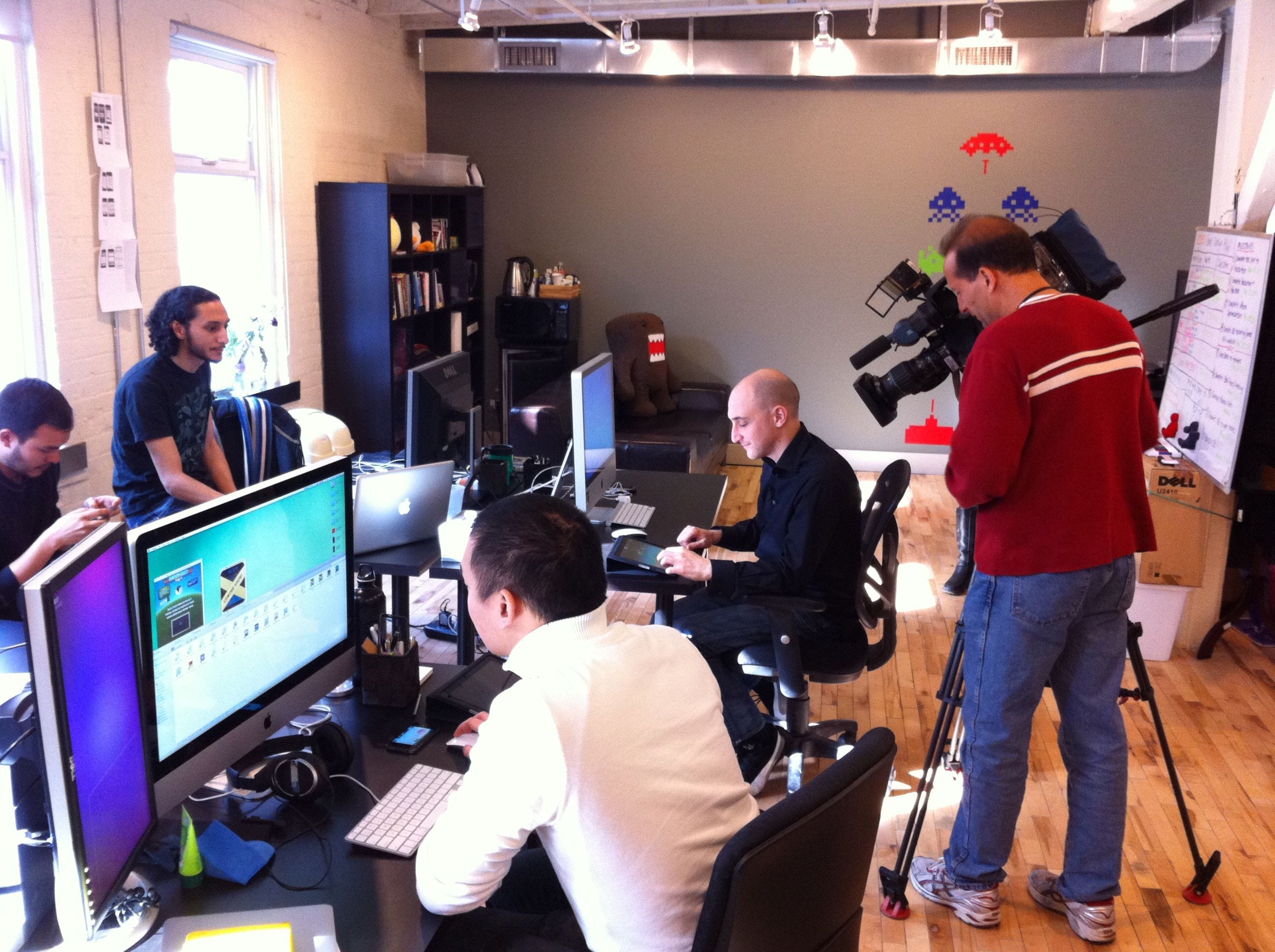
Around 2007 I was the product owner bringing Ontario’s desktop telemedicine product to market, the public-sector version of what Maple and Dialogue would later turn into actual businesses. Whoops. Good gig. Three days a week I built that, and the other two I spent building something of my own, because I’ve always been an itchy entrepreneurial type. Some old colleagues, Ken and Garry Seto, saw what I was up to and wanted in, so I brought them over. Their own side hustle, Endloop, took off first: they shipped iMockups, one of the first thirty apps on the iPad App Store, and it caught because it took Steve Jobs’ idea of the iPad as a creative device rather than a consumption one and ran with it. In 2010 they called me to be their CEO.
Who gets that call? Not necessarily the most qualified person. What did I know about sales, PR, fundraising, video games, or equity? But I could build product at scale and I’d put in years next to Ken and Garry. The call didn’t come because I was the safest hire on paper. It came because the work and the relationships had quietly made me the obvious one when the seat opened up.
I’ve come to believe in engineered serendipity - the idea that you intentionally set yourself up for luck to happen. You work with interesting and ambitious people, build and ship products and content, be out there, and trust that proximity + output + time manufactures the kind of luck that will never come find you otherwise.
But you also need to be around long enough to have opportunities come your way. As Paul Graham put it, you need to be default alive.
Looking back on last year’s StartupFest, I had three very different conversations that got me thinking about time horizons.
Moon Time
Madison Feehan runs SpaceCopy out of Alberta, and the business is 3D-printing infrastructure on the moon out of the dust already up there. Lunar regolith, what the rest of us would call moon dust, crushed and characterized and printed into housing, roadways, launch pads, beams, over 250 things you’d otherwise have to fly into space at a price per kilo that makes no economic sense. Her timeline is geological. The zero-gravity test flight is slated for late 2026, the moon itself is roughly five years out, and she’s spent about $200,000 to get this far against a $5 million raise, she tells me. Printing with regolith, she noted, is “much like working with shards of glass.” Not a fun time, and not a fast one.
So how does she stay default alive until that time comes - especially as a deep tech startup? Fixing door hinges that keep breaking in Nunavut, plus vehicle parts the manufacturer no longer makes, printed on Earth 70% cheaper and 20% faster than flying them in. She claims she’s sitting on 300 pre-orders before the moon pays a dime. This isn’t a put-AI-on-the-moon-or-go-bust-in-a-year startup. This is doing a hard thing over a long period of time, so patience and resilience matter.
Brain Time
Joshua Lyttle is at the opposite end of the dial. He’s a biomedical engineering student in his final year, and his company, Mindfully, is building a non-invasive EEG wearable that reads your prefrontal cortex (FP1 and FP2, if you want to sound smart) and flags when you’re about to relapse on a habit before you’ve decided to. The clock he cares about is the smallest one here: the few seconds between the craving and the caving, between knowing what you should do and doing what you shouldn’t anyways.
The irony is that the founder fixated on the shortest clock there is has signed up for a long, tough slog. Reading the prefrontal cortex accurately enough to flag a relapse before it happens is not a two-year project, and nothing about it is guaranteed to work. He’s measuring milliseconds and committing to a decade, and he isn’t pretending it’s anything less. The difference between him and almost everyone else pitching that day is that he can afford to be wrong slowly: he’s in his final year, his founder clock reads “after I graduate,” and a decade poured into something that doesn’t pan out still leaves him young enough to start over. He isn’t outrunning his clock; for once it’s running, to an extent, in the founder’s favour.
Borrowed Time
Then there’s Katy Yam at Real Ventures, running a clock shaped nothing like the other two. Real manages $320 million across four funds, last raised in 2017, and isn’t writing new checks into new companies at the moment - it’s realizing the portfolio, returning capital, collecting on old bets like Xanadu, the quantum computing company that was still a wager when we spoke and is public now. A fund has its own time pressure, just a different kind: you deploy while the clock is young, into things that can plausibly pay out before it runs out, then hand the money back on schedule, because those returns are what let you raise the next fund at all. Madison and Joshua are racing to exist. Katy is racing a contract, and the next one behind it.
What actually kills companies, she says, is rarely the market. It’s the people: the founder who breaks before the company does (something I subscribe to wholeheartedly). Real has pulled founders out to, in her words, stabilize them as humans then reinsert them, because a founder who quietly runs out of stamina is just a clock running out before the luck arrives. She runs the one clock here with a hard date on it, and what she’s learned watching founders is that the clock that kills you is the one you’re not even looking at.
Face Time
The three of them are running clocks that don’t resemble each other at all, but the move underneath is identical. Madison stays alive fixing door hinges in Nunavut. Joshua gets to be wrong slowly. Katy spends her days keeping founders from breaking before the bet matures. Not one of them can make the luck arrive on schedule. All any of them can do is still be in the room when it decides to.
The call to run Endloop found me because I’d spent years next to Ken and Garry, shipping, being around - default alive - and letting proximity and output do what they do. In 2011, it almost happened again. We got a call from Zynga, at the time a super hot company. They were shopping for mobile companies, so they flew us to San Francisco, showed us how the machine worked, and sat us down with their M&A team and the mobile lead doing the acquiring. Zynga ended up buying Five Mobile, a 50-person shop in Toronto run by Ameet Shah. Now Ameet’s a fancy VC at Golden Ventures, but at least I’ve still got my looks.