

I pay a flat subscription to Claude and ChatGPT, like many people, and live within the means of that plan. I know there are APIs but consumption-based pricing scares the crap out of me. In fact, my CLAUDE.md file (the instructions that tell Claude how to behave) reflects my cheapness and has a line that says “default down, escalate on purpose” with the exchange rate of Haiku 1x, Sonnet 3x, Opus 5x, and Fable 10x. Like the olden days of cellular phones and long distance, I’m rationing my AI usage.
What triggered me to write this was a note from Notion announcing it’s once again changing their pricing, and the online reaction to it. I’ve been a customer of theirs since the early days, which means I watched it go from unlimited AI use on business plans in May of 2025 to promising “spending limits and alerts” in October of 2026 over the course of 17 months. (Max Nardit has a deeper dive on this in “A price you cannot compute“). Simultaneously this week, Plaud the AI wearable note-taker, split its basic transcription and summary minutes from its smarter agent features, much to the chagrin of some Reddit users. Both drew the line in the same place: the flat fee covers what’s cheap, as it always did, and the meter turns on when you start using AI and the marginal cost starts.
SaaS purgatory
We’re now living in SaaS purgatory. Pre-AI, you were paying for access. Fees were flat because the incremental costs of a user were negligible. But now, every AI request burns compute and thus cost. These software companies find themselves in a situation where they are paying for tokens, so they need to pass along the cost (or cost plus) to somebody, and it’s landing on their customers. But consumers and businesses hate being metered. Consumers don’t want to think about it, which is how phone plans went from per-minute, to capped, to “unlimited”. Businesses have a different complaint: the CFO can’t forecast a cost that runs wild every time someone deploys an agent. Phones only got to unlimited once minutes stopped costing carriers basically anything, so maybe tokens can get there too. One can only hope...
Metering has been around for a while and isn’t completely hated everywhere. AWS charges by the hour, the gigabyte, and the request and businesses pay. Before AWS, if you’re old enough to remember, a software company bought machines, power, and staff anticipating demand which was very expensive and could never materialize. With AWS, the cost starts at near zero and the price scales up with usage driven, ideally, by more customers. So, the price goes up when things are going well. (Yes, I’m aware that a whole discipline, FinOps, exists to tame these bills. I don’t claim love, just tolerance). AI spend isn’t there yet: for now the token bill goes up when your team creates curious agents, not when your revenue goes up.
Please call us for pricing
So, in theory, the fix is to hook the meter to something the buyer wants more of. You actually see it today in the right hand side of any SaaS pricing grid: the “Call Us” section. The incremental software cost is negligible for the SaaS company but the salespeople you talk to are trying to discover the problem you have and price based on the value it creates in your organization. Outcome-based pricing, or results-as-a-service (RaaS, or some other acronym that we’ll all be sick of by the spring) is the attempt to automate that, one conversation at a time. Don’t pay for an AI to do outbound, pay for meetings booked. Don’t pay for a support bot, pay per ticket resolved. The price gets set against a salary instead of a server, which is a much easier number to win an argument with and is far less expensive (plus it doesn’t go on sick leave).
A step in this direction is Quo. It used to be OpenPhone, a digital business phone system, and rebranded around an AI receptionist named Sona that bills per call: 10 free a month, then $25 for 40, with overage fees you can switch off “for a predictable bill”. They are not yet promising outcomes, like resolving customer issues, but you can see where that would be the next logical step.
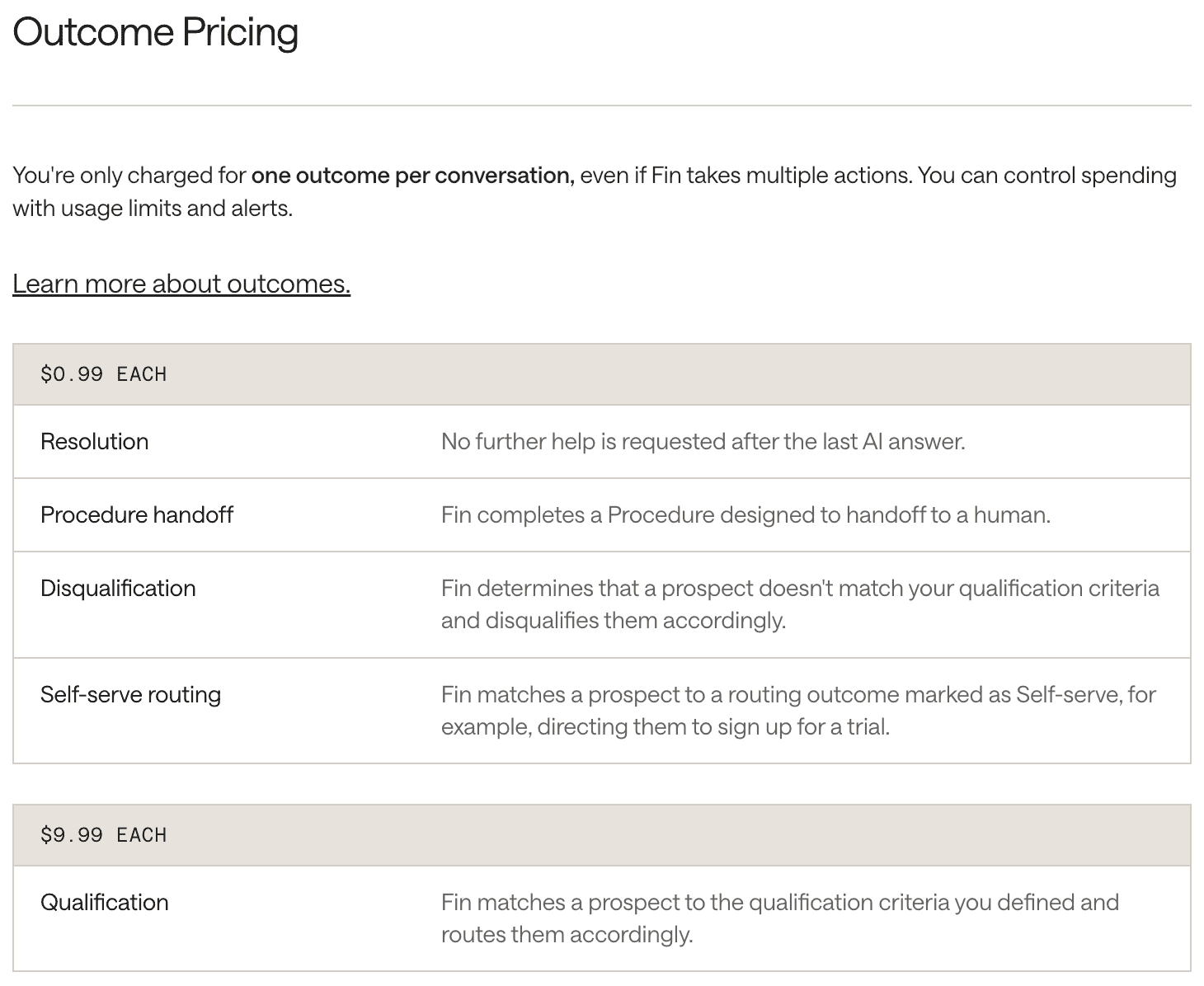
Intercom has taken that logical step with an agent called Fin. You pay from $29 per month plus 99 cents per “outcome”, with the image above describing what outcomes mean. But outcomes can be quite complex. A customer success leader in the startup space told me that a simple “resolution” - getting someone off of the phone as quickly as possible - is not what they are looking for. They’re looking for retention or another metric that is more complex than these initial agents can offer. Of course, a huge company whose customers are stuck with them may be A-OK with paying for silence.
How’s it gonna end, Rob?
Well, if I knew that I’d be rich. Agent piles of money rich. I’ve been focused up until this point on solving the vendor’s problem (cost and margin). But I’ve not addressed the buyer’s problem, which is knowing the bill in advance. Today it’s a seat price, plus some mushy credits, plus an allowance whose size isn’t published. Notion will now let you bring your own ChatGPT plan so you don’t have to “pay twice”, which is cool but also feels like Russian nesting meter dolls, and further obscures the cost. Plus, at the moment, nobody outside of the labs knows what a token actually costs to serve.
I’m not sure that cheap tokens will end up the way cheap minutes on cell phone bills did, either. Phone calls had a natural ceiling: there are only so many people you can talk to and so many hours in the day. There’s no such ceiling on agents, so cheaper tokens mean more agents running longer (Jevons paradox with GPUs, not coal).
If outcome pricing wins (and I’m willing to bet on a version of it, if the agents deliver), we end up with software priced against a salary, since everyone understands a salary. But nobody has figured out how to put an agent on a performance improvement plan.